What EHRs Underestimate about Supporting MIPS
MIPS is a performance-based payment adjustment program for clinicians. In reality, a clinician’s success or failure in MIPS depend heavily on the EHR. CMS mandates require EHRs to be a system of record, calculation engine, workflow enforcer, and submission pipeline for MIPS.
Today, any EHR serving MIPS-eligible clinicians is expected to maintain certified modules, deliver annual eCQM updates, manage evolving measure logic, align with MVPs, support submission testing, integrate with multiple MIPS vendors, and sustain reliable, ongoing connectivity with CMS. This is not episodic work. It is continuous, deadline-driven, and unforgiving.
As a result, MIPS now materially shapes engineering roadmaps, release coordination, and customer support operations throughout the year, often at the expense of core product innovation.
This blog breaks down where MIPS demands surface across EHR operations, why the effort grows heavier every year, and how Darena Health enables EHRs to offload much of that burden by integrating with MyMipsScore, supporting MIPS at scale without rebuilding their platforms or owning the full lifecycle.
Annual MIPS tasks for EHRs
Every MIPS performance year begins with a reset. For EHRs, this is not a policy review exercise. It is the start of another cycle of engineering, compliance, and operational work driven by CMS rulemaking.
At the outset, EHR teams must:
Interpret the CMS Final Rule and identify measure, scoring, and participation changes
Confirm which eCQMs, CQMs, and MVPs remain valid and which require updates or replacement
Analyze updated value sets and specifications that impact calculations and data capture
Assess downstream effects on ONC-certified modules and certification timelines
Evaluate changes affecting new clinician types, subgroups, or reporting pathways
This initial work sets the direction, but it does not contain the effort. As the year progresses, clarifications emerge, edge cases surface, and real-world data exposes gaps between specification and implementation.
Throughout the performance year, EHRs are also responsible for:
Updating workflows and logic to reflect evolving measure definitions
Coordinating releases around CMS deadlines while minimizing customer disruption
Supporting submission testing, validation, and troubleshooting across multiple MIPS vendors
Maintaining reliable CMS connectivity and submission pipelines
Handling customer support escalations tied to performance discrepancies and submission failures
As real-world data flows through the system, additional work surfaces. EHRs investigate data capture gaps that affect measure completeness, adjust logic to handle edge cases, and respond to customer questions about missing measures or unexpected scores. As submission deadlines approach, issues must be resolved quickly, often under CMS validation feedback and fixed timelines.
For both executives and product leaders, the outcome is the same. MIPS becomes a continuous, deadline-driven operational obligation that shapes roadmaps, consumes engineering capacity, and diverts focus from core product innovation.
What Most EHRs Underestimate
Most EHRs underestimate how little of this work is one-time and how much of it must be repeated, validated, and supported every year. Measure logic changes, certification impacts, submission pathways, and CMS integrations compound over time. The effort grows even when clinician flexibility and upside continue to shrink.
What EHRs Can Offload with Integration
EHRs do not need to own the full MIPS lifecycle to support their customers. By integrating with MyMipsScore, EHRs can offload:
Annual MIPS rule interpretation and measure updates
eCQM and CQM logic maintenance and validation
MVP alignment and reporting support
Submission testing and CMS pipeline management
Ongoing connectivity with CMS and MIPS vendors
Make CQM (registry) measures available to their customers
Integration enables EHRs to meet MIPS requirements, support their customers, and reduce risk, without rebuilding infrastructure or dedicating internal teams throughout the year for MIPS.
Where the Work Quietly Adds Up
MIPS-related work rarely grows in one obvious spike. It accumulates.
Each performance year introduces incremental updates across eCQMs, CQMs, Promoting Interoperability measures, and MVP specifications. Individually, these changes may seem manageable. Collectively, they trigger recurring certification reviews, engineering updates, QA cycles, and documentation work that add on to the normal release planning.
Over time, MIPS begins to resemble a parallel operational track that must be maintained alongside the core platform.
Managing coverage becomes increasingly difficult.
CMS continues to evolve the eCQMs, CQMs, and MVP-specific measures. Measures are retired, replaced, or moved into MVPs every year with limited or no heads-up. Customers expect access to what CMS supports, even when maintaining full coverage strains EHR’s capacity.
Each additional measure brings its own logic, exclusions, data requirements, and scoring nuances. As inventories constantly change, long-term maintenance effort increases.
MVPs further raise the bar.
While intended to streamline reporting for clinicians, MVPs demand higher precision from EHRs. Measure groupings, specialty alignment, and validation rules are stricter than traditional MIPS. Many commonly used measures are now only available only within MVPs. Gaps or outdated mappings may not surface immediately, but they often appear later as submission failures or scoring discrepancies.
Submission work concentrates risk near deadlines.
MIPS submission is not a simple file transfer. It requires secure CMS connectivity, strict formatting, validation logic, and the ability to respond quickly to CMS errors or rejections. Issues frequently surface late in the reporting cycle, when timelines are tight, and customer pressure is highest.
Customers demand a MIPS dashboard.
EHR customers expect a user-friendly dashboard that translates raw data into performance tracking, data completeness checks, and predictable scoring outcomes. Meeting this expectation requires CMS-aligned logic and confidence that what customers see throughout the year matches final submission results.
Many failures are operational, not clinical.
Zero scores and penalties often result from missing fields, incorrect identifiers, or data file issues rather than poor performance. These issues are difficult to detect without deep familiarity with CMS rules, measure calculation, and scoring logic.
Support demand peaks close to the reporting period
As the submission period approaches, demand for MIPS support spikes. Questions often require regulatory interpretation or technical expertise, pulling engineering, product, and compliance teams away from planned work.
Integration risk is always a consideration
All of this occurs while EHRs remain rightly cautious about integration risk. Any MIPS capability must be additive, stable, and non-disruptive to existing ASTP/ONC certification and production environments.
How Darena Health Absorbs MIPS Complexity
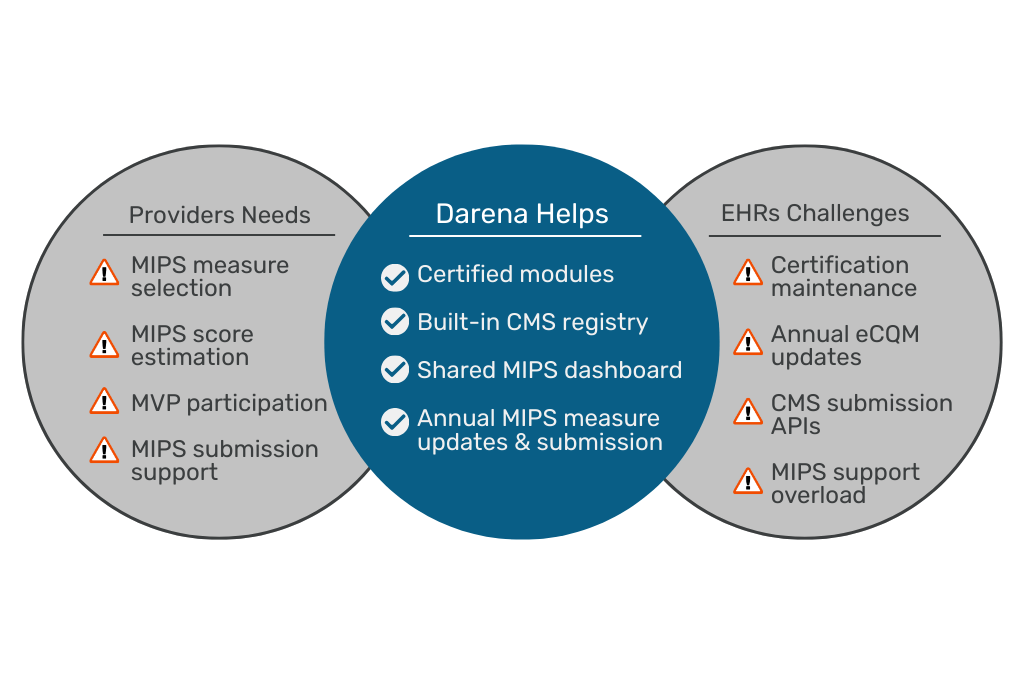
Darena Health helps EHRs treat MIPS as an operational function rather than an internal project that expands every year.
Through MyMipsScore, we centralize the parts of MIPS that change most frequently and generate the most overhead. Measure logic, value sets, MVP mappings, and CMS submission workflows are maintained as requirements evolve. EHRs integrate once and avoid rebuilding, revalidating, or re-certifying MIPS functionality year after year.
MyMipsScore provides eCQM, CQM, and MVP coverage without requiring EHRs to maintain each measure internally. Darena operates as a CMS Qualified Registry, managing submission validation, connectivity, and transmission to CMS. This removes the need for EHRs to build and maintain registry infrastructure or carry the associated compliance burden.
Built on Certified, Proven Infrastructure
MyMipsScore is built on ASTP/ONC Certified Health IT infrastructure. It is certified across (c)(1-4), (g)(7-10) and (b)(11) modules for recording, calculating, importing, exporting, filtering, and reporting on all eCQMs, as well as additional modules supporting access control, auditability, and safety.
This certification depth allows MIPS capabilities to be integrated into existing EHR environments without interfering with an EHR’s current certification status or production stability. It also supports Promoting Interoperability measures that require capabilities many solutions do not provide.
Darena has supported multiple specialty-focused EHRs for many years, helping them meet MIPS requirements while minimizing disruption to core systems. Our role is to absorb regulatory change so EHRs can stay focused on building and supporting the products their customers rely on.
A More Sustainable Way to Support MIPS
MIPS already demands significant time, coordination, and expertise from EHR teams today. Offloading that work sooner creates immediate leverage.
For EHRs planning for the 2026 performance year, starting the integration conversation now gives product, engineering, and support teams more time back and, in many cases, reduces total cost. It also enables EHRs to offer MIPS as a value-added service to their customers, creating a new revenue stream while keeping clinicians engaged in performance monitoring throughout the year.